
A logo is a single symbol; a brand system design is the entire ecosystem (colors, typography, motion, and rules) that allows your brand to look professional across every platform. In 2026, a lone logo isn’t enough to scale. You need a scalable visual identity to build global trust.
Let’s be honest: in the early days of a business, it’s tempting to hop onto a cheap design site, pay $50 for a logo, and call it a day. But as we move further into 2026, that “quick fix” is becoming a major roadblock for growth.
If you want to move from being a “local startup” to a global impact venture, you have to stop thinking about your brand as a single image. You need to start thinking about brand system design.
At Leke Tech, we’ve seen dozens of entrepreneurs struggle because their visual identity couldn’t keep up with their ambition. Here is why the “Logo-only” era is over, and how a scalable system changes the game for your business.
What is Brand System Design? (A Definition)
Brand system design is a strategic framework of visual and verbal elements including logos, typography, color palettes, motion guidelines, and sound cues that work together to create a consistent and recognizable brand presence across all digital and physical touchpoints.
Unlike a static logo, a brand system is adaptive. It’s the “DNA” of your business. It ensures that whether a client sees your brand on a 3-inch smartwatch screen, a 4K video ad, or a physical billboard in Douala, they recognize you instantly.
Why a “Lone Logo” Fails the 2026 Test
In the past, you could get away with one logo because your brand only lived in a few places: a storefront, a business card, and maybe a basic website. Today, your startup’s visual identity has to perform in a much more complex environment.
1. The Multi-Platform Struggle
A logo that looks great on a white background might disappear in “Dark Mode” on a mobile app. A complex, detailed emblem might look like a blurry smudge as a social media favicon. Scalable logo systems solve this by providing multiple versions of your mark, primary, stacked, and simplified designed for specific contexts.
2. The Trust Gap
In the global market, trust is the primary currency. If your Instagram ads look different from your website, and your pitch deck looks like it belongs to a different company entirely, you create “brand friction.” International clients associate consistency with reliability. International brand guidelines act as a promise that your quality is as consistent as your visuals.
3. The “Static” Problem
2026 is the year of motion-first branding. If your logo can’t move, it’s invisible on platforms like TikTok, Reels, and digital signage. A brand system includes rules for how your elements animate, slide, and react, making your brand feel “alive.”
Logo vs. Brand System: A Quick Comparison
| Feature | Single Logo | Brand System Design |
| Components | One static image file | Logo variations, type, colors, motion, icons |
| Adaptability | Rigid; hard to fit in small spaces | Flexible; scales from favicons to billboards |
| Consistency | High risk of “visual drift” | Enforced through international brand guidelines |
| Scalability | Limits your professional growth | Built to grow with your product line |
| AI Readiness | Hard for AI to categorize | Easy for AI to identify and recommend |
The 4 Pillars of a Scalable Visual Identity
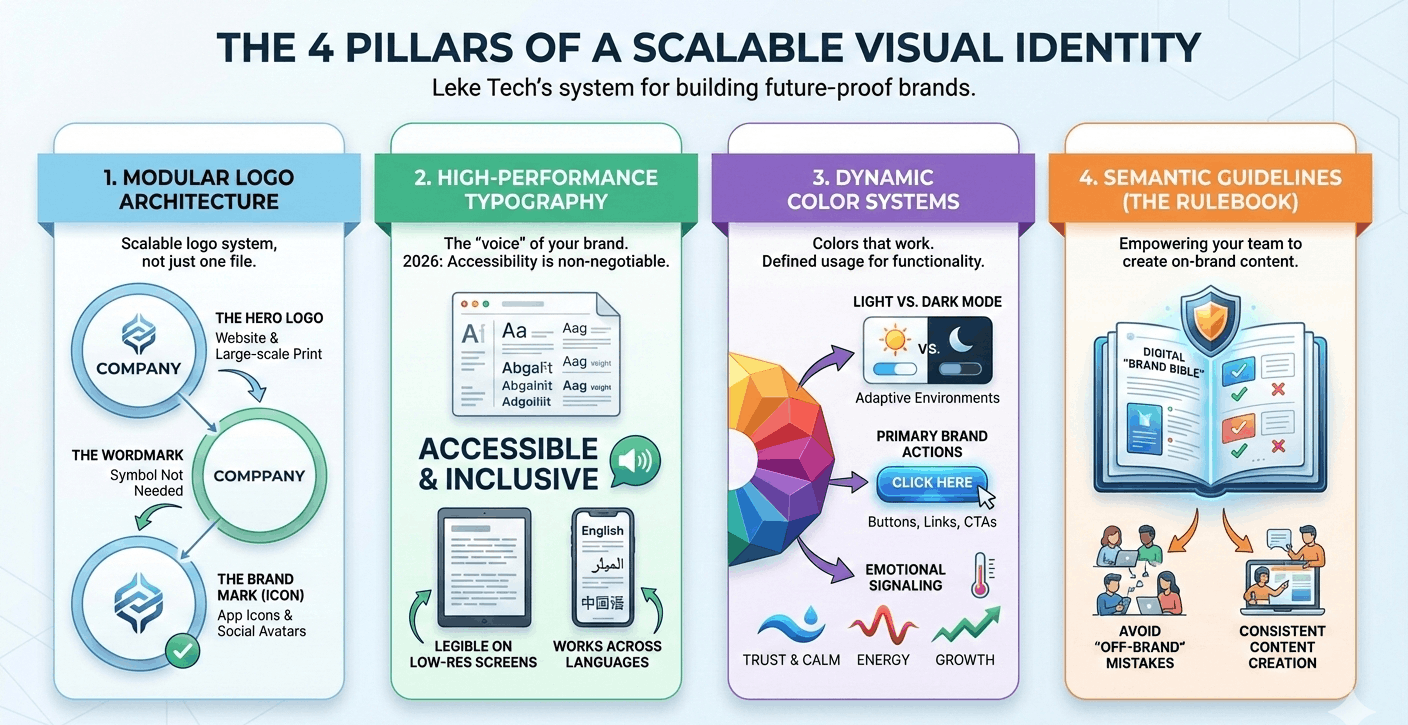
When we build a system at Leke Tech, we focus on four core pillars that ensure your brand is future-proof.
1. Modular Logo Architecture
We don’t just give you one file. We provide a scalable logo system. This includes:
-
The Hero Logo: For your website and large-scale print.
-
The Wordmark: For when the symbol isn’t needed.
-
The Brand Mark (Icon): Optimized for app icons and social avatars.
2. High-Performance Typography
Typography is the “voice” of your brand. In 2026, accessibility is non-negotiable. We select typefaces that are legible on low-resolution screens and work across different languages, ensuring your international brand guidelines are inclusive.
3. Dynamic Color Systems
Colors shouldn’t just look “cool.” They need to work. A modern system defines color usage for:
-
Light vs. Dark Mode
-
Primary Brand Actions (buttons, links)
-
Emotional Signaling (trust, energy, or calm)
4. Semantic Guidelines (The Rulebook)
This is where many startups fail. Having the assets is only half the battle; knowing how to use them is the other half. We provide a digital “Brand Bible” that empowers your team to create content without ever looking “off-brand.”
Why African Startups Need Systems to Go Global
As a Cameroonian-founded company, Leke Tech understands a unique challenge: African startups are often fighting an “authority bias.” To win over international investors and clients, your startup’s visual identity must look ten times more professional than the competition.
A comprehensive brand system design bridges that gap. It signals that you aren’t just a “small business” you are a world-class organization with the infrastructure to back it up.
FAQ: Scaling Your Brand Identity
Q: How much does a full brand system design cost?
While a simple logo might be cheap, a system is an investment. Prices vary based on the complexity of your business, but it typically replaces the need for constant redesigns, saving you thousands in the long run.
Q: Can I turn my existing logo into a brand system?
Absolutely. This is called a “Brand Evolution.” We take your core mark and build the secondary elements (typography, color, motion) around it to make it scalable for 2026.
Q: Does my business really need motion guidelines?
If you use social media or video marketing, yes. Motion is a key part of digital excellence in Cameroon and beyond. It makes your brand look premium and modern.
Ready to Move Beyond the Logo?
Your brand is more than a mark; it’s an experience. Don’t let a static logo hold back your global potential. Whether you are a founder in Douala or a startup in London, Leke Tech is here to help you build a scalable visual identity that commands attention.
Is your brand ready for 2026?
Book a Brand Audit with Leke Tech →
check out our portfolio






One Response
Usually I don’t learn article on blogs, but I wish to say that this write-up very forced me to check out and do it!
Your writing style has been surprised me.
Thanks, very nice post.